
What Is a GT3 Car? How GT3 Race Cars Work
GT3 race cars are production-based machines built for professional and amateur circuit racing. Learn how they differ from road cars, how Balance of Performance works, and where GT3 fits among modern sports-car categories.
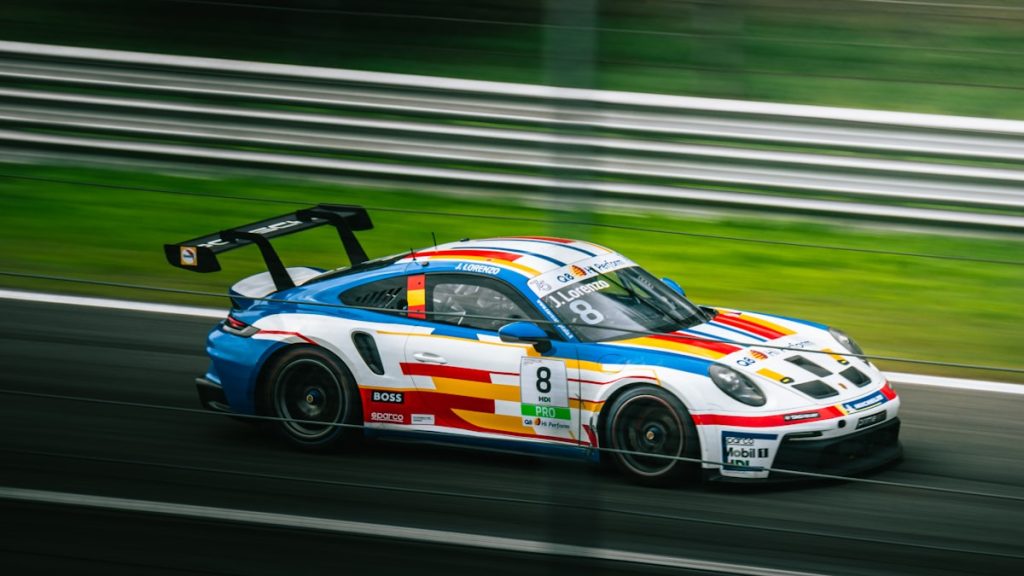
GT3 race cars are competition versions of high-performance road cars, built to a common set of technical regulations for closed-circuit racing. They may share a name, engine layout, and body shape with a showroom model, but a GT3 car is far more specialized underneath. It is designed for speed, durability, predictable handling, and long race stints rather than everyday driving.
What defines a GT3 race car?
A GT3 car must be based on a production sports car and approved, or homologated, by the Fédération Internationale de l’Automobile (FIA) or the relevant racing authority. Manufacturers develop the car around a road-going model, then replace or heavily modify many components for competition.
Typical GT3 equipment includes a large aerodynamic rear wing, a front splitter, racing suspension, carbon-fibre body panels, slick or rain tyres, a competition gearbox, and a stripped interior with a roll cage and racing seat. The cockpit also contains safety systems such as a fire extinguisher, window net, harnesses, and an emergency electrical cut-off.
The engine is usually related to the road car’s power unit, but its cooling, electronics, exhaust, intake, and calibration are adapted for racing. Many GT3 cars use advanced traction control and antilock braking systems. These aids are not there to make the car easy to drive; they help drivers manage a powerful machine consistently over a long event.
How different is a GT3 car from its road version?
The visual connection can be obvious, but the driving experience is not. A road car needs ground clearance, noise insulation, comfortable seats, emissions equipment, luggage space, and predictable behaviour in traffic. A GT3 car needs maximum grip, rapid maintenance, efficient cooling, and stable performance at racing speeds.
That difference affects almost everything. The ride is extremely stiff, the steering is direct, and the brakes are built to withstand repeated heavy stops. Aerodynamic downforce pushes the car into the track at speed, while racing tyres provide much more grip than ordinary road tyres. The cabin is noisy, visibility is compromised by safety equipment, and low-speed manoeuvring can be awkward.
Even a road-legal performance model carrying the same badge is not simply a GT3 car with number plates. A race version may use a different gearbox, suspension geometry, cooling system, electronics package, and body structure. The relationship is best understood as a competition car derived from a production design, not as a lightly modified road car.
What is Balance of Performance?
One of the defining features of modern GT3 racing is Balance of Performance, usually shortened to BoP. GT3 manufacturers build cars with different engines, layouts, weights, and aerodynamic characteristics. Without regulation, one design could gain a lasting advantage over the others.
BoP systems use tools such as minimum weight, engine power limits, air restrictors, turbo boost controls, ride-height requirements, and fuel-capacity adjustments to keep the cars competitive. The goal is not to make every vehicle identical. A front-engined Mercedes-AMG, a mid-engined Ferrari, and a rear-engined Porsche can still feel very different, but their overall race potential is managed within a competitive window.
BoP is also why raw horsepower figures can be misleading. A car with a larger engine does not automatically have an advantage, and comparing published road-car specifications tells you little about its likely performance in a GT3 championship. Tyre behaviour, cornering balance, fuel use, pit-stop requirements, and how well the car treats its tyres may matter more than peak power.
Where do GT3 cars race?
GT3 machinery competes in major international events and national championships. The category is especially common in endurance racing, where teams share cars between two or more drivers. Events such as the 24 Hours of Spa and races in the Intercontinental GT Challenge feature large GT3 grids, while series such as the GT World Challenge use the class as their main attraction.
GT3 cars also compete in multi-class races alongside prototypes or other types of touring and sports cars. Their speed is high enough to demand professional-level preparation, but the regulations and customer-racing support make the category accessible to private teams as well as factory-backed operations.
Manufacturers commonly sell GT3 cars to customer teams rather than entering every car directly themselves. A purchase usually includes technical support, spare parts, software, engineering assistance, and access to updated setup information. Running one is still expensive: tyres, engines, crash damage, transport, mechanics, data engineers, and testing quickly add to the cost.
GT3 compared with GT4 and other GT categories
GT3 sits above GT4 in performance and cost. GT4 cars are also based on production models, but they generally produce less downforce, use less sophisticated aerodynamics, and offer a more affordable route into professional racing. GT4 is often used by developing drivers and teams, while GT3 is a top-level customer category.
GT3 is also distinct from GTE, the class formerly used at events such as the 24 Hours of Le Mans. GTE regulations allowed more extensive race-specific development, while GT3 became the more widely adopted global platform for production-based endurance racing. Some championships use different local names or variations, so the exact rules should always be checked for the series involved.
Why are GT3 cars so popular?
GT3 racing works because it combines recognisable sports-car identities with genuinely demanding competition. Fans can connect a BMW, Aston Martin, Chevrolet, Ferrari, Lamborghini, Lexus, McLaren, Mercedes-AMG, or Porsche GT3 car to a production brand, while teams receive a proven platform that can race across different circuits and championships.
For drivers, the cars offer a serious test of braking, tyre management, traffic judgement, data analysis, and consistency. For spectators, the mixture of different engine layouts and body styles creates close racing without requiring every car to be mechanically identical. That balance is what makes GT3 one of the most important categories in modern sports-car racing.